The Collected Stories of Vernor Vinge

Related Posts
The Gap Cycle The Real Story: The Gap into Conflict Book 1

Angus Thermopyle was an ore pirate and a murderer; even the most disreputable asteroid pilots of Delta Sector stayed locked out of his way.  Those who didn't ended up in the lockup--or dead.  But when Thermopyle arrived at Mallory's Bar & Sleep Read more

The Eye of Sounnu by Schuyler Hernstrom (recent sword and sorcery stories)

Once upon a time, short fiction was the mainstay of science fiction and fantasy readers. Titans like Robert E. Howard and Jack Vance worked their magic on magazine and pulp pages, delighting readers with strange visions and pulse pounding action. Read more

Since his first published story, “Apartness,” appeared in 1965, Vernor Vinge has forged a unique and awe-inspiring career in science fiction as his work has grown and matured. He is now one of the most celebrated science fiction writers in the field , having won the field’s top award, the Hugo, for each of his last two novels.

Now, for the first time, this illustrious author gathers all his short fiction into a single volume. This collection is truly the definitive Vinge, capturing his visionary ideas at their very best. It also contains a never-before-published novella, one that represents precisely what this collection encapsulates–bold, unique, challenging science fictional ideas brought to vivid life with compelling storytelling.

Including such major pieces as “The Ungoverned” and “The Blabber,” this sumptuous volume will satisfy any reader who loves the sense of wonder, and the excitement of great SF.

I, Robot by Isaac Asimov

I, Robot by Isaac Asimov
Date:
MainCategory:
Lenght:
Author:
Narrator:
Receptions: ,

Here are stories of robots gone mad, of mind-read robots, and robots with a sense of humor. Of robot politicians, and robots who secretly run the world – all told with the dramatic blend of science fact and science fiction that has become Asmiov’s trademark.

The three laws of Robotics: 1) A robot may not injure a human being or, through inaction, allow a human being to come to harm 2) A robot must obey orders given to it by human beings except where such orders would conflict with the First Law. 3) A robot must protect its own existence as long as such protection does not conflict with the First or Second Law.

With these three, simple directives, Isaac Asimov changed our perception of robots forever when he formulated the laws governing their behavior. In I, Robot, Asimov chronicles the development of the robot through a series of interlinked stories: from its primitive origins in the present to its ultimate perfection in the not-so-distant future – a future in which humanity itself may be rendered obsolete.

Ad Astra by Jack Campbell

From the author of the New York Times–bestselling Lost Fleet series comes 11 action-packed stories of space exploration.

In   Lost Fleet series, Jack Campbell’s hero Captain “Black Jack” Geary explores the furthest reaches of space. Here, Campbell explores what kinds of problems mankind might face as our horizons expand. The third in a series of collections of Campbell’s short stories includes some of Campbell’s favorite stories, and some of his earliest. A brand-new author’s note accompanies each story.

“Lady Be Good” is one of Campbell’s most popular stories, winner of Analog magazine’s “AnLab” reader poll for Best Short Story and cited in Gardner Dozois’s Year’s Best SF.  The Lady Be Good is an old ship, running obscure routes (not all on the right side of the law), with her loyal first officer Kilcannon and reclusive captain. When Kilcannon decides to rescue the survivors of an attack on a Vestral Company ship, a mysterious new passenger thanks him by asking difficult questions about the Lady, with unexpected answers.

In “Kyrie Eleison,” the Verio shipwrecked centuries ago on an out-of-the-way planet, and the descendants of the ship’s survivors have gotten along as well as they can by following the orders that were passed on to them. But those orders weren’t intended to govern life on the planet’s surface, and when the Bellegrange arrives on a rescue mission, her captain will have to reckon with the unexpected social order on the planet.

In “Do No Harm”, a ship is so technologically advanced that it can repair itself—but turning over the keys might not be the best idea. And in “Down the Rabbit Hole,” a series of failed attempts at faster-than-light travel lead to a novel approach: sending an untested Naval captain out in a space ship to see if he can figure out what’s gone wrong.

With eleven stories in all, Ad Astra is the most multi-faceted introduction to the short fiction of Jack Campbell, and an essential complement to his bestselling book-length work.

Borrowed Time

Borrowed Time
Date:
MainCategory:
Lenght:
Narrator:

A collection of seven time-bending sci-fi stories by the author of the New York Times–bestselling Lost Fleet series—with new author’s notes for each story.

In “Betty Knox and Dictionary Jones in The Mystery of the Missing Teenage Anachronisms,” a pair of time travelers get stuck in 1964—and in the bodies of their fifteen-year-old selves. It’s a terrible time to have other time travelers looking to kill you. SFRevu called this story “one of the most enjoyable reads I’ve had in a long time.”

In four interlinked short stories, a pair of Temporal Interventionists try to solve some of history’s greatest mysteries—from the origin of the Spanish Flu to an unexplained explosion in the world’s least-inhabited region in 1908. Why were ironclad warships being developed by both the South and the North at the exact same time during the American Civil War? And why don’t we know who fired the ‘shot heard ’round the world,’ the lone gunshot that started the American Revolution?

In “Joan,” a time-traveling researcher named Kate has gotten a little too close to Joan of Arc, both emotionally and temporally—and now has a chance to rescue her from being burnt at the stake. And in the final story, “Crow’s Feat,” a skeptical writer goes back to Elizabethan England to discover the true author of Shakespeare’s plays.

Bass Reeves Frontier Marshal

Bass Reeves Frontier Marshal
Date:
MainCategory:
Genre:
Lenght:
Seriesize:

TALES OF A
WESTERN LEGEND

He began his life as a slave. During the Civil War he escaped and lived among the Indians of the Five Civilized Tribes in the Oklahoma Territories. He learned to ride, shoot and track prey from his adopted people. When the war ended, he was recruited as one of the first black marshals in the history of the west.

In a thirty year career, operating under the authority of Judge Parker out of Fort Smith, he captured over three thousand outlaws, was involved in fourteen major gun battles and never wounded once. At the ended of his career, he became a Deputy Sheriff in Tuskegee until his death at the age of 70. He is considered the greatest western lawman that ever lived.

Writers Gary Phillips, Mel Odom, Andrew Salmon and Derrick Ferguson have whipped up four action packed adventures inspired by this legendary figure. Tales of a wild frontier where outlaws and renegades roamed freely until the coming of one amazing man who wore a badge and vowed to bring justice to one and all. He was Bass Reeves—Frontier Marshal.

Griots: A Sword and Soul Anthology

Magic. Myth. Warfare. Wonder. Beauty. Bravery. Glamour. Gore. Sorcery. Sensuality. These and many more elements of fantasy await you in the pages of Griots, which brings you the latest stories of the new genre called Sword and Soul.

The tales told in Griots are the annals of the Africa that was, as well as Africas that never were, may have been, or should have been. They are the legends of a continent and people emerging from shadows thrust upon them in the past. They are the sagas sung by the modern heirs of the African story-tellers known by many names – including griots.

Here, you will meet mighty warriors, seductive sorceresses, ambitious monarchs, and cunning courtesans. Here, you will journey through the vast variety of settings Africa offers, and inspires. Here, you will savor what the writings of the modern-day griots have to offer: journeys through limitless vistas of the imagination, with a touch of color and a taste of soul.

RIDICULUM: Classic pulp sci-fi tales with a humorous twist

RIDICULUM: Classic pulp sci-fi tales with a humorous twist
MainCategory:
trope:
Lenght:

Let’s face it… doom and gloom is an easy sell. Readers do love their tales of bleak futures and apocalyptic hellscapes. So much so, it seems that publishers have forgotten we readers also like to laugh. And with times being what they are, we’re ALL in need of a few good laughs.

Now, what if I told you there was once a time when sci-fi magazines routinely printed comedic tales about absurdist dystopias, twisted robot logic, and time travel shenanigans gone awry? Of aliens behaving badly, and hyper-intelligent mice toppling the national security state? That films like Idiocrasy borrowed heavily from these stories. As did Bill & Ted’s Excellent Adventure. And Douglas Adams all but owed his career to these golden age galactic romps.

Ridiculum is an anthology that collects some of the best (and unfortunately forgotten) comedic stories from the pulp era, including works by genre legends such as Philip K. Dick, Murray Leinster, Robert Sheckley, Harry Harrison, John D MacDonald, C. L. Moore, Henry Kutter, and more.

Indeed, this anthology is so good, here’s what some AI on the internet said about it:
“I never thought I’d see any of these stories again, but I was wrong. Ridiculum is a treasure trove of fun nostalgia!”

How can you argue with that? And this digital edition is only $0.99! So what are you waiting for? Buy this book! Read it cover to cover. Leave a review and let everyone know how swell it is.ng as they are, we’re all in need of some light-hearted fun.

Northwest Smith

Northwest Smith
Date:
MainCategory:
trope:
Lenght:
Author:
Reception:

Meet the iconic space outlaw who “could be Han Solo’s grandfather,” in these stories by a pioneer of Golden Age science fiction (SF Signal).

First published in Weird Tales in the early 1930s, C.L. Moore’s Northwest Smith stories, especially “Shambleau,” were hailed as some of the most imaginative and vivid science fiction stories ever to come out of the golden age of sci-fi. At a time when women were heavily underrepresented in the genre, Moore was among the first to gain critical and popular acclaim, and decades later was inducted into the Science Fiction and Fantasy Hall of Fame.

Northwest Smith, now recognized by many as the archetypal space smuggler and gunslinger, is an adventurer in the classic sense of the word, and these thirteen stories chronicle the bizarre dangers, interstellar wonders, and titillating romances that captured the imagination of a generation.

Robots Have No Tails (complete collection of Galloway Gallegher stories)

 from “one of the major names in science fiction” (The New York Times).

In this comprehensive collection, Henry Kuttner is back with Galloway Gallegher, his most beloved character in the stories that helped make him famous. Gallegher is a binge-drinking scientist who’s a genius when drunk and totally clueless sober. Hounded by creditors and government officials, he wakes from each bender to discover a new invention designed to solve all his problems—if only he knew how it worked . . .

Add a vain and uncooperative robot assistant, a heckling grandfather, and a host of uninvited guests—from rabbit-like aliens to time-traveling mafia lawyers to his own future corpse—and Gallegher has more on his hands than even he can handle. Time for another drink!

“[A] pomegranate writer: popping with seeds—full of ideas.” —Ray Bradbury, author of Fahrenheit 421

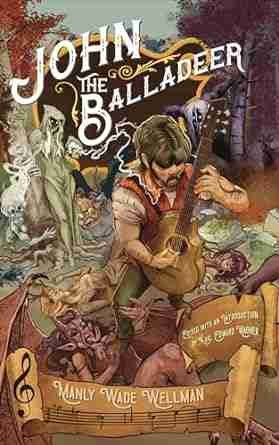
John the Balladeer by Manly Wade Wellman

In John the Balladeer, Manly Wade Wellman created one of the great characters in all of horror and fantasy literature. Armed with his silver-stringed guitar and an endless trove of folk songs, John travels the backwoods of Appalachia, battling supernatural evil with his own brand of down-home charm and endless resourcefulness. In these tales, John wanders the Southern mountains, encountering hoodoo men and witch women, strange supernatural beasts, malevolent spirits, and even George Washington’s ghost.

Edited by horror legend Karl Edward Wagner, this volume contains the complete John the Balladeer stories in their original, unaltered form, as they first appeared in magazines and anthologies between 1951 and 1987. Also featured are a foreword by Wellman’s friend and literary executor David Drake and an introduction by Wagner.

“Just as J. R. R. Tolkien brilliantly created a modern British myth cycle, so did Manly Wade Wellman give to us an imaginary world of purely American fact, fantasy and song.” – Karl Edward Wagner

“This is the real thing-a book of haunting fantasies with their roots going down deep into the American folk tradition.” – Robert Silverberg